












Sales–Marketing Alignment Isn’t a Tech Problem. It’s a Partnership Condition.

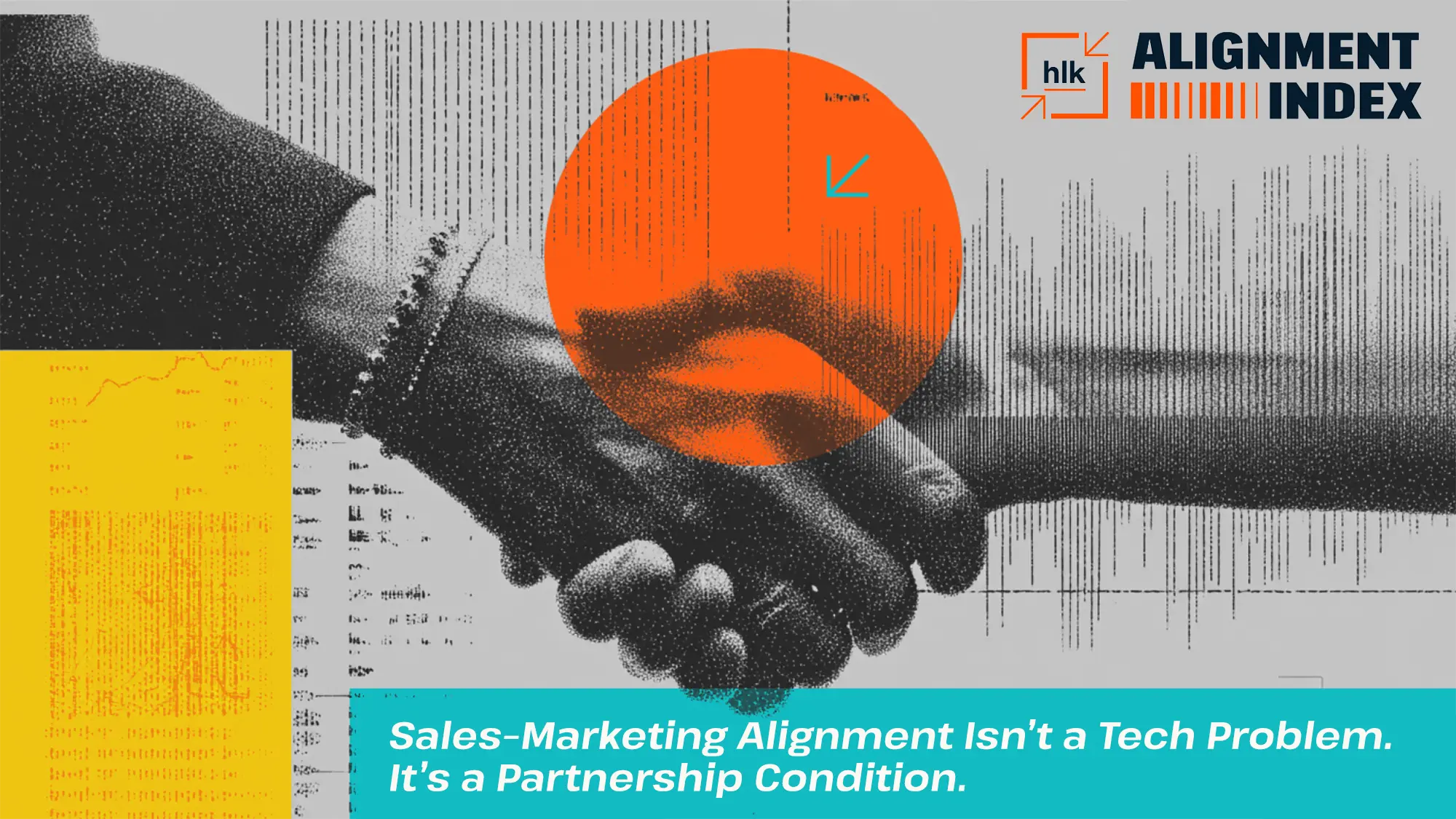
Graphic for the “HLK ALIGNMENT INDEX” featuring a handshake overlaid with a large orange circle and a teal arrow. A banner at the bottom reads, “Sales-Marketing Alignment Isn’t a Tech Problem. It’s a Partnership Condition.”

B2B teams don’t invest in tools because they love software. They invest because something feels broken

  • Sales says marketing “doesn’t get the reality of the field.” 
  • Marketing says sales “doesn’t follow up.” 
  • Everyone blames the funnel. And the tech stack keeps growing — CRMs, automation, enablement platforms, dashboards — all promising unity.

But our newest HLK research suggests a harder truth: Sales–marketing alignment is a partnership condition disguised as a technology or process problem. Your tools aren’t failing you — the partnership is.
What HLK studied

HLK surveyed 1,040 B2B leaders and conducted 20 qualitative interviews with B2B CEOs, CMOs, CROs, and VPs across a range of industries. We wanted to understand what separates teams who say they’re aligned from teams who actually operate like they are.

A lockup of the HLK logo and texts that reads "Alignment Index".

The Alignment Index

We built an Alignment Index (0–100) to quantify perceived alignment. High-performing teams consistently excel across five interconnected dimensions:

  1. Collaboration — working together effectively 
  2. Shared goals — a common definition of success 
  3. Culture / cohesion — celebrating shared wins 
  4. Trust — confidence in intentions 
  5. Leadership — modeling and reinforcement

These aren’t “nice-to-haves.” They’re the conditions that decide whether your systems and processes work — or simply create new places to argue.

Key finding #1: Mutual respect is the strongest signal

Across the dataset, mutual respect between sales and marketing emerged as the clearest divider between high-alignment and low-alignment organizations. When mutual respect is high, teams can:

  • Disagree without fracture 
  • Collaborate through long sales cycles 
  • Hold each other accountable without defensiveness

One leader put it plainly: “Tech failed because we skipped the hard relational work.”

Key finding #2: ABM doesn’t create alignment — it reveals it.

ABM is often sold as the alignment cure. Our data says it’s closer to a mirror.

Organizations reporting strong ABM experiences showed meaningfully higher alignment — often 25–30 points higher on the Index — but ownership of ABM didn’t matter. Marketing-led, sales-led, jointly owned: none consistently outperformed.

Translation: ABM doesn’t fix the partnership. It exposes its actual health.

Key finding #3: The “fixes” leaders chase miss the roots.

Many organizations respond to misalignment by buying technology, reorganizing teams, or redefining process. Those can help — but they rarely solve the core issue when the partnership is weak.

Long buying cycles breed resentment. Misaligned KPIs create conflict by design. And when trust is low, even good leads feel like a fight.

As one CEO told us: “We’ve spent hundreds of thousands on great technology… and it didn’t generate a single sale — not because the software was bad, but because we hadn’t done the upfront hard work.”

The Takeaway

Alignment is felt by people first, long before it shows up in pipeline reports. When the partnership erodes, performance follows.

If you’re seeing:

  • Finger-pointing over lead quality
  • Out-of-sync messaging
  • Stalled cycles and delayed marketing impact 
  • Fragmented tools that promised unity but delivered distance 

…you don’t need another platform. You need to rebuild partnership conditions.


We’ll continue sharing additional findings from this research in the months ahead — further defining the conditions that separate aligned teams from the rest.